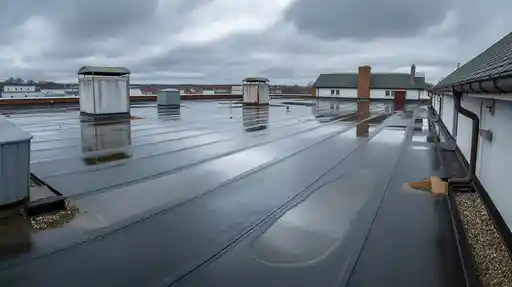
Flat commercial roofs in Southern New Hampshire and Northern Massachusetts often resemble silent pools waiting to tell a story. Whether you’re in Nashua, Manchester, Bedford, Merrimack, Londonderry, Hudson, Derry, Salem, or Concord, the challenge is the same: standing water refusing to drain. In climates where winter’s melting snow meets spring’s sudden downpours, ponding water on a flat roof isn’t just an eyesore—it’s a prelude to leaks, structural strain, and costly repairs.
Problem
Ponding water collects when a low-slope or aging roof system loses its natural lean. You’ve seen it: a shallow basin of stormwater, gleaming under a gray New England sky. Without a graceful slope toward scuppers or gutters, water lingers. Over time, the membrane softens. Seams loosen. What began as a few shallow puddles deepens into persistent pools.
Impact
Left unchecked, ponding water accelerates membrane fatigue. Flashing seams around HVAC units, vents, and expansion joints become vulnerable. Roof decks warp under hydrostatic pressure. Ice forms in winter, widening cracks like an artist’s deliberate brushstroke. The result is unpredictable leaks—sometimes a single drip in Bedford, other times a waterfall in Merrimack—undermining insulation and inviting mold.
The emotional toll is real. Homeowners worry about insurance claims, interior damage, and the safety of maintenance crews. Financially, even minor roof repairs in Concord can escalate into full replacements north of $20,000.
Mechanism
Understanding the mechanics is the first step toward control:
An old EPDM membrane loses elasticity after decades under UV and freeze-thaw cycles. A seamless TPO roof may slump if its edge drains clog with leaves. Improperly installed tapered insulation fails to guide water to scuppers. Gutters corrode. Scuppers rust shut.
Solutions align with causes:
Inspection: A professional evaluates slope, membrane integrity, flashing and expansion-joint condition.
Drain Clearing: Roof drains and scuppers receive routine cleaning to restore free flow.
Tapered Insulation: Strategically placed to create a gentle incline, directing water toward outlets.
Additional Scuppers or Overflow Drains: Introduced to handle sudden deluges, common in Salem’s spring storms.
Roof Coating: A durable acrylic or silicone layer seals micro-cracks and extends membrane life.
Benefits
Addressing ponding water delivers tangible gains:
• Extended Roof Lifespan: Proper drainage halts the cycle of water intrusion and freeze damage.
• Energy Savings: A dry insulation deck maintains R-values, lowering heating costs in Derry’s chilly mornings.
• Code Compliance: Municipal codes in Hudson and Londonderry demand safe drainage rates, avoiding penalties.
• Peace of Mind: You know that every rainfall drains away, not under the membrane.
Outcome
Imagine a roof that sheds water like a duck’s back, even as spring sleet gives way to summer storms. No more anxious rooftop inspections in the drizzle. No more surprise leaks in the kitchen ceiling. Instead, predictability. Security. A well-tuned roof system that stands guard year after year.
The transformation is more than technical—it’s psychological. You regain confidence in your home’s resilience and protect your investment against New England’s temperamental weather.
Frequently Asked Questions
How often should a flat commercial roof be inspected for ponding water?
An expert inspection at least twice a year—typically in spring and fall—is recommended. After heavy snowmelt or windstorms common to Manchester and Nashua, a quick check can catch blockages before they worsen.
Can I add tapered insulation over an existing membrane?
Yes, provided the underlying deck is sound and the current membrane has no active leaks. Tapered insulation creates a built-in slope for improved roof drainage without a full tear-off.
Will installing additional drains void my roof warranty?
Not if the work is performed by a certified installer following manufacturer guidelines. Always verify with your roofing system’s warranty provider before modifying drainage components.
What is the cost range for ponding water solutions on a flat roof?
Simple drain clearing and coating can start around $1.50–$3 per sq. ft. Tapered insulation or adding scuppers may range from $4–$8 per sq. ft., depending on accessibility and material choice.
Which membrane performs best in New England’s freeze-thaw cycles?
EPDM remains popular for its proven durability in extreme temperatures. TPO and PVC offer heat-welded seams and reflectivity, reducing summer heat gain, but require careful installation to resist snow-load stresses.
For homeowners in New Hampshire or Massachusetts looking to maintain a safe and reliable home exterior, the team at Revive Roofing & Siding remains available for guidance, inspections, and detailed evaluations.
Website: reviveroofingandsidingllc.com
Email: reviveroofingandsidingnh@gmail.com
Phone: +1 (603) 560-5309